The Endoscopic Advantage: Redefining the Future of Spine Surgery
The Endoscopic Advantage: Redefining the Future of Spine Surgery
In the modern era, "minimally invasive" is not just an option—it is the standard of care aimed at maximizing patient safety and accelerating recovery. At the pinnacle of this evolution is Endoscopic Spine Surgery (ESS). With over 30 years of continuous development, ESS has reached a level of maturity that offers unparalleled precision.
What is ESS? The Concept of "Ultra-Minimal" Invasiveness
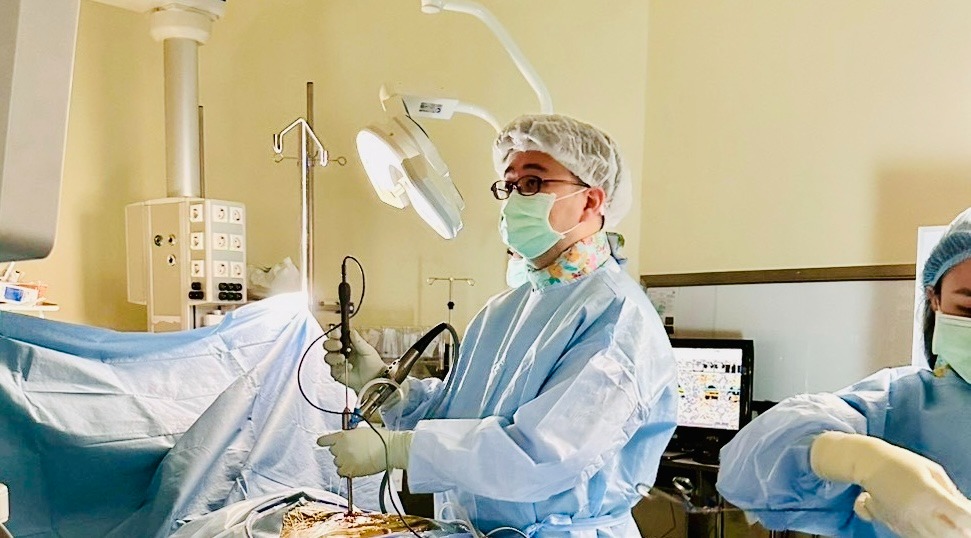
The core of ESS involves using a high-definition (HD) endoscope inserted through a tiny 8 mm portal to reach the spinal pathology directly. It is widely recognized as one of the least invasive surgical methods available today due to:
- Muscle-Preserving Philosophy: Unlike traditional surgery, which requires extensive muscle stripping, endoscopy gently dilates the muscle fibers, resulting in significantly less tissue damage.
- Continuous Irrigation System: The procedure is performed within a constant flow of saline, providing a crystal-clear view of neural structures, minimizing the injury and heat generation, and also maintaining excellent hemostasis.
Evidence-Based Outcomes and Long-term Stability
Global research—including studies I have contributed to—confirms that ESS provides clinical outcomes comparable to traditional microscopic surgery. However, it offers several key advantages:
- Significantly Lower Infection Rates: Large-scale meta-analyses show that ESS diminishes surgical site infections compared to non-endoscopic procedures.
- Superior Recovery Metrics: Patients experience less blood loss, fewer incidental durotomies (CSF leaks), and shorter hospital stays.
- High Patient Satisfaction: With reduced post-operative pain, patients achieve functional recovery and return to work much sooner.
The Future of Endoscopic Spine Surgery
We are entering a "paradigm shift" where endoscopic indications are expanding to complex cases, including spinal fusion, tumor management, and infection treatment. The future projection includes:
- Navigation-Guided ESS: Utilizing 3D mapping for pinpoint accuracy during complex procedures.
- Augmented Reality (AR): Integrating digital overlays to enhance the surgeon's visualization and ensure the highest safety margins.
However, as all patients' conditions are varied and the decision-making process should be individualized, the feasibility of doing spinal endoscopy might not be the same for each patient. Consultation with a spine and endoscopic specialist is strongly recommended.
References
- Jitpakdee, K., Liu, Y., Heo, D. H., Kotheeranurak, V., Suvithayasiri, S., & Kim, J. S. (2023). "Minimally invasive endoscopy in spine surgery: where are we now?" European Spine Journal. [Link]
- Chin, B. Z., Yong, J. H., Wang, E., Sim, S. I., Lin, S., Wu, P. H., & Hey, H. W. D. (2024). "Full-endoscopic versus microscopic spinal decompression for lumbar spinal stenosis: a systematic review & meta-analysis." The Spine Journal. [Link]
- Mahan, M. A., et al. (2023). "Full-endoscopic spine surgery diminishes surgical site infections - a propensity score-matched analysis." The Spine Journal. [Link]

Questions about your symptoms?
Chat with us on LINE for more information
@bright.endospine
Chat on LINE