
Microscope vs. Endoscope: Understanding Your "Camera Surgery" Options
Microscope vs. Endoscope: Understanding Your "Camera Surgery" Options
When patients are advised to undergo "camera surgery" for their spine, it is completely normal to feel a bit confused. In the medical field, this term can refer to two very different technologies. As a surgeon continuously learning and evaluating the best pathways for patient recovery, I want to break down the differences between a Microscope and an Endoscope in simple, everyday language.
1. Microscopic Surgery (Microdiscectomy/decompression)
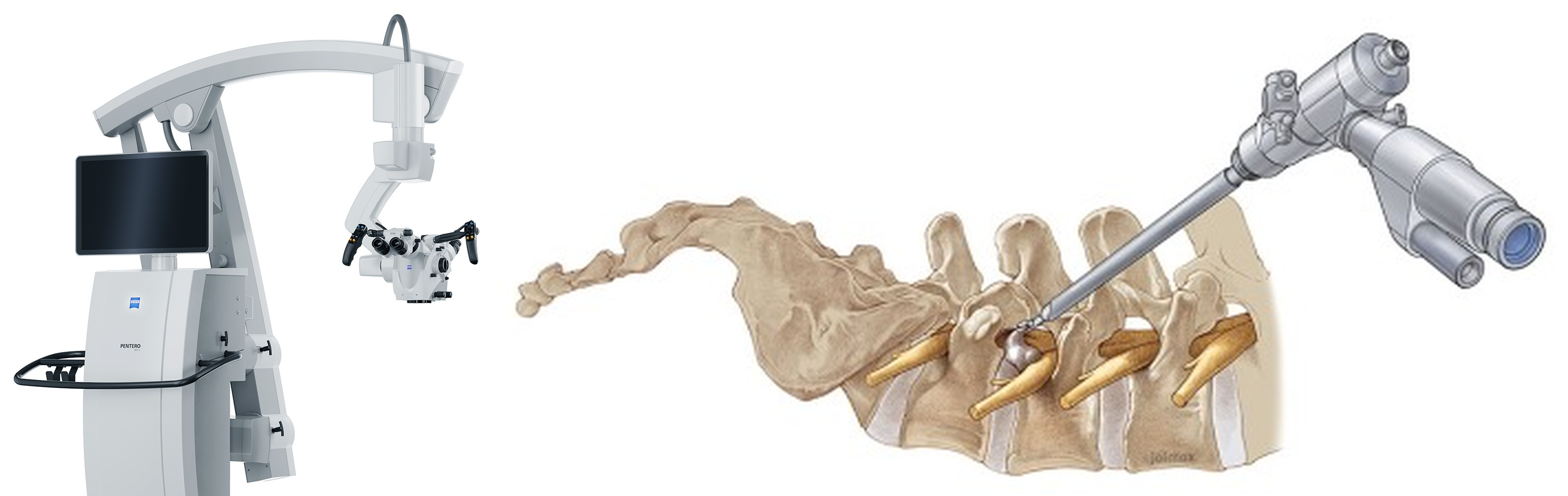
This has been the gold standard for many years and yields excellent results. The surgeon uses a powerful, large microscope positioned "outside" of the patient's body, looking down into the surgical field.
- The View: Imagine standing at the edge of a well and looking down to the bottom with high-powered binoculars.
- The Approach: While the skin incision is small, the underlying muscles still need to be pulled aside (retracted) to create a funnel-shaped pathway so that light and the surgeon's line of sight can reach the compressed nerve.
2. Endoscopic Surgery (Full-Endoscopic spine)
This is a modern technology designed to minimize tissue disruption. An endoscope is a thin tube, about 7-8 millimeters wide, with a high-definition lens right at its tip.
- The View: Instead of looking from the outside in, we bring our "eyes" directly inside your body. The camera is placed right next to the spinal pathology, offering extreme clarity.
- The Water System: A crucial feature of the endoscope is its continuous irrigation system. A constant flow of saline washes over the area during surgery, keeping the view perfectly clear and minimizing tissue damage.
What Does the Data Say?
Large-scale medical studies show that both techniques are highly effective at relieving pain. However, the Endoscopic approach shows distinct advantages in the recovery phase:
- Faster Recovery: Less blood loss and a shorter hospital stay.
- Ultra-Low Infection Risk: Significantly lower rates of surgical site infection, thanks to the tiny incision and the continuous washing effect of the irrigation fluid.
- Precision & Safety: Fewer instances of incidental dural tears (CSF leakage).
- Long-term Value: Early studies indicate that despite being an advanced technology, endoscopic surgery is highly cost-effective over the long term due to fewer complications and faster recovery.
However, as all patients' conditions are varied and the decision-making process should be individualized, the feasibility of doing spinal endoscopy might not be the same for each patient. Consultation with a spine specialist is strongly recommended.
References
- Chin, B. Z., Yong, J. H., Wang, E., Sim, S. I., Lin, S., Wu, P. H., & Hey, H. W. D. (2024). "Full-endoscopic versus microscopic spinal decompression for lumbar spinal stenosis: a systematic review & meta-analysis." The Spine Journal. [Link]
- Mahan, M. A., et al. (2023). "Full-endoscopic spine surgery diminishes surgical site infections - a propensity score-matched analysis." The Spine Journal. [Link]
- Choi, K. C., et al. (2019). "Cost-effectiveness of microdiscectomy versus endoscopic discectomy for lumbar disc herniation." The Spine Journal. [Link]

Questions about your symptoms?
Chat with us on LINE for more information
@bright.endospine
Chat on LINE