One Incision or Two? Understanding Uniportal vs. Biportal Endoscopic Spine Surgery
One Incision or Two? Understanding Uniportal vs. Biportal Endoscopic Spine Surgery
As patients research minimally invasive spine surgery, they frequently come across two specific terms: Uniportal (1-incision or full-endoscopy) and Biportal (2-incision or UBE). Both are fantastic, minimally invasive techniques that yield excellent clinical outcomes. However, they differ significantly in their surgical approach.
The Technical Differences
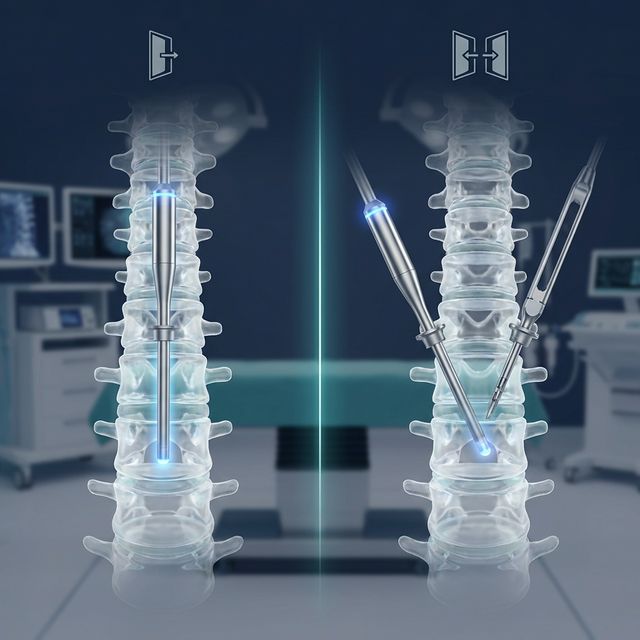
- Biportal Endoscopy (UBE): This technique requires two separate small incisions. One portal is used exclusively for the camera (the surgeon's eyes), while the other is used for the surgical instruments to perform the decompression.
- Uniportal Endoscopy (Full-Endoscopic): This utilizes a single, tiny incision (approximately 8 millimeters). The specialized endoscope contains both the high-definition camera and a working channel within the exact same tube, meaning both the vision and the instruments follow the exact same path.
The Philosophy Behind the Single Portal
In the surgical community, it is well known that Full-Endoscopic (Uniportal) surgery has a steeper and longer "learning curve" compared to the biportal approach. Operating through a single, highly constrained corridor is technically demanding.
However, mastering this challenge has always been my passion. By dedicating myself to rigorous training and supervision from the very beginning, my goal has always been to deliver the most refined technique possible. My personal philosophy is simple: If both techniques provide the same excellent relief from nerve compression, why make two incisions when the same goal can be achieved with just one? This is my personal opinion, but if fewer incisions generally mean less tissue disruption and a more comfortable experience for the patient, why don’t we chase for it?
While I have a strong affinity for the uniportal approach, it is important to remember that every surgical tool has its specific purpose.
However, as all patients' conditions are varied and the decision-making process should be individualized, the feasibility of doing spinal endoscopy might not be the same for each patient. Consultation with a spine specialist is strongly recommended.
References
- Jitpakdee, K., Liu, Y., Heo, D. H., Kotheeranurak, V., Suvithayasiri, S., & Kim, J. S. (2023). "Minimally invasive endoscopy in spine surgery: where are we now?" European Spine Journal. [Link]
- Choi, D. J., et al. (2016). "Learning Curve Associated with Complications in Biportal Endoscopic Spinal Surgery: Challenges and Strategies." Asian Spine Journal. [Link]

Questions about your symptoms?
Chat with us on LINE for more information
@bright.endospine
Chat on LINE