Back pain radiating down the leg when you cough, sneeze, or sit: causes, initial care, and when to see a doctor
People with radiating leg pain often describe it in similar terms: after sitting at work for a long stretch, a dull ache settles into the lower back, and then the pain may radiate down into the buttock, thigh, calf, or foot. Some describe it as an electric-shock sensation; others feel numbness or a tingling, prickling feeling. And a common observation is that the radiating leg pain becomes more pronounced when coughing, sneezing, or straining.
These symptoms can be a source of worry, particularly when they disturb sleep or daily activities. The questions patients most often ask are: what is this, is surgery necessary, and will it improve on its own? Dr. Siravich (Bright) has prepared this article to explain, plainly and on the basis of current medical evidence, how to understand the symptom and how to approach initial care.
Note: this article focuses on how to respond to the symptom. To understand the underlying mechanism — why pain radiates down the leg when a nerve root is compressed — please read the in-depth explainer → Sciatica: Radiating Leg Pain Explained — Causes & Symptoms
Why does coughing or sneezing make the leg pain worse?
When you cough, sneeze, or strain, the pressure inside the abdomen and spinal canal rises momentarily. If a disc fragment is already pressing against a nerve, this added pressure presses harder on the inflamed area, so the radiating leg pain flares in waves. By the same mechanism, many patients find their symptoms worsen when sitting for long periods (sitting loads the lumbar discs more than standing or lying down) and ease when they stand, change position, or lean back.
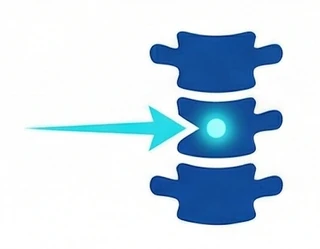
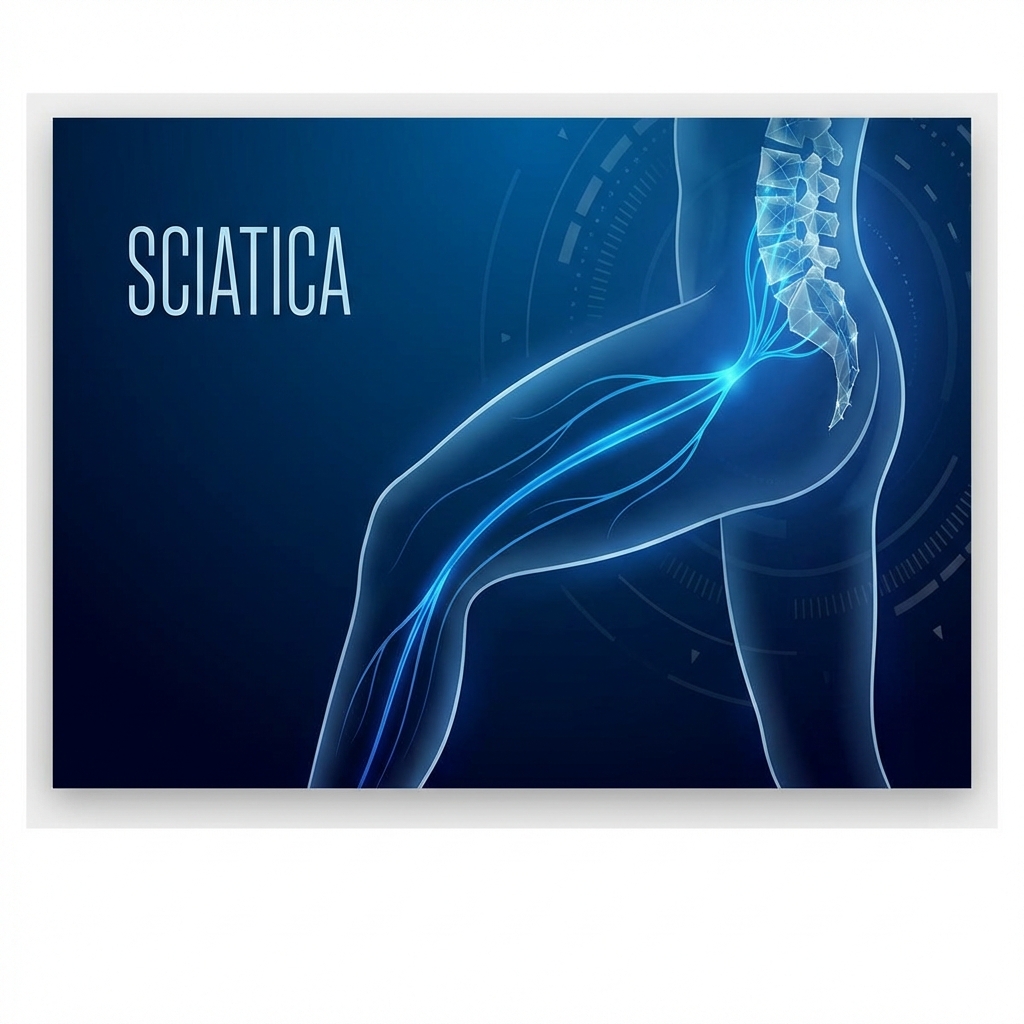
In medical terms this pattern is called sciatica — pain along the path of the sciatic nerve. Sciatica is not a disease in itself; it is a set of symptoms indicating that a nerve in the lower back is being irritated. The most common cause is a herniated disc, though other causes are possible. A definite diagnosis therefore requires a physical examination and, in some cases, imaging such as MRI.
A fact worth knowing: most patients do not need surgery
An important fact patients should understand from the outset is that most radiating leg pain from a herniated disc can improve on its own without surgery. The body has natural mechanisms to gradually reduce the inflammation and resorb the herniated portion of the disc. A large body of medical research indicates that many patients improve over the first weeks to months with non-surgical care.
Non-surgical care (conservative treatment) usually combines several approaches, such as:
- Anti-inflammatory and pain-relieving medication as advised by your doctor or pharmacist (taking anti-inflammatories on your own continuously for long periods without medical advice is not recommended).
- Adjusting posture and daily habits — avoiding prolonged uninterrupted sitting, changing position frequently, and taking care with bending and heavy lifting.
- Appropriate physical activity — current care guidance does not recommend prolonged bed rest; instead it advises gradually returning to movement and normal activities as tolerated (staying active), under the guidance of a doctor or physiotherapist. This is consistent with a Cochrane systematic review and international clinical guidelines such as the UK's NICE, which indicate that prolonged bed rest is no better than remaining normally active.
- Targeted injections in selected cases your doctor judges appropriate.
The key to non-surgical care is time and consistency — not searching for a way to "fix it instantly."
When should you not wait to see a doctor?
Although most patients gradually improve on their own, a few warning signs indicate you should see a doctor promptly, without waiting it out, because they may signal severe nerve compression. These include:
- Progressively worsening leg weakness — for example, inability to lift the front of the foot, tripping, or the leg giving way.
- Numbness around the buttock and genital area (saddle anesthesia).
- Loss of bladder or bowel control — incontinence, or unusual difficulty passing urine.
- Pain so severe that ordinary painkillers cannot relieve it, especially severe pain at night.
- Fever together with back pain, or a history of cancer.
These belong to a group covered in a separate article, with the reasons some of them count as emergencies → 5 Spine Red Flags You Should Never Ignore
If you have symptoms in this group, seeing a doctor quickly is not overreacting — it is protecting the nerve from lasting damage.
If full non-surgical care has not helped: surgical options
If a patient has had appropriate non-surgical care for a period of time (the duration depends on the individual's symptoms and the doctor's judgement) but the radiating leg pain still seriously disrupts daily life, or there is clear numbness or weakness consistent with the MRI findings, the doctor may begin to discuss surgical options with the patient.
One minimally invasive option available today is removing only the disc fragment pressing on the nerve using an endoscope (Endoscopic Lumbar Discectomy) — a small camera through an incision of about 8 mm. A clinical study (a randomised controlled trial published in the BMJ) comparing endoscopic surgery with standard open surgery found that a far higher proportion of patients in the endoscopic group could be discharged home on the same day as surgery, with overall recovery no worse than open surgery. For the details of who is and is not a suitable candidate, how the procedure is performed, the recovery time, and the honest risks, please see this page:
The key point to understand: "operable" does not mean "must operate"
This is a common misunderstanding, so it is worth stating clearly: the fact that technology allows surgery through a smaller incision does not mean that everyone with radiating leg pain should have surgery. Choosing the right patient for the right treatment (patient selection) matters just as much as the surgical technique itself. Some patients are better served by continuing non-surgical care, while others have conditions for which standard open surgery or a spinal fusion may be more appropriate and safer. Endoscopy is not the answer for every pathology.
An appropriate decision therefore comes from a consultation with a spine specialist who has examined the patient, performed a physical examination, and reviewed the patient's MRI together — not from reading a single article (this one included). This article is only a starting point to help patients understand their condition and ask their doctor better questions.
FAQ
Q: I have radiating leg pain — do I need surgery right away?
A: Usually not. Many patients improve with non-surgical care over the first weeks to months. Doctors generally consider surgery when full non-surgical care has not helped, or when there is weakness or a warning sign.
Q: Why does coughing or sneezing make the leg pain worse?
A: Coughing, sneezing, or straining briefly raises the pressure in the spinal canal, pressing harder on a nerve that a disc fragment is already irritating — so the leg pain flares in waves.
Q: Sitting makes it worse — should I lie still and avoid moving?
A: Prolonged complete bed rest is usually not the best approach. Current guidance recommends gradually returning to appropriate movement under the guidance of your doctor or physiotherapist, which tends to aid recovery more than staying still.
Q: Is it dangerous to leave it for a while?
A: Ordinary pain that is gradually improving is usually not urgent. But if you develop worsening leg weakness, numbness around the buttock and genital area, or loss of bladder or bowel control, see a doctor promptly — do not wait it out (see the "red flags" article).
Q: After endoscopic surgery, is it cured for good and won't come back?
A: Surgery relieves the mechanical compression of the nerve, but it does not stop the natural degeneration of the spine, so recurrence is still possible — it is not a "permanent cure." That is why self-care after surgery matters (details on the procedure page).
Every patient's situation differs in its details. This information helps with the overall picture, but decisions should be individualized together with a spine specialist.
References
- Jitpakdee, K., Liu, Y., Heo, D. H., Kotheeranurak, V., Suvithayasiri, S., & Kim, J. S. (2023). "Minimally invasive endoscopy in spine surgery: where are we now?" European Spine Journal. [Link]
- Gadjradj, P. S., et al. (2022). "Full endoscopic versus open discectomy for sciatica: randomised controlled non-inferiority trial." BMJ. [Link]
- Dahm, K. T., Brurberg, K. G., Jamtvedt, G., & Hagen, K. B. (2010). "Advice to rest in bed versus advice to stay active for acute low-back pain and sciatica." Cochrane Database of Systematic Reviews. [Link]
- National Institute for Health and Care Excellence (NICE). "Low back pain and sciatica in over 16s: assessment and management" (NG59). [Link]

Questions about your symptoms?
Chat with us on LINE for more information
@bright.endospine
Chat on LINE