
Spondylolisthesis (a slipped vertebra): back pain, leg pain, walking shorter distances — when it can be managed without surgery, and when to see a doctor
Many people who are examined for ongoing low-back pain, or back pain that radiates into the leg, hear the word "spondylolisthesis" — a slipped vertebra — from their doctor or on an X-ray report, and immediately worry: "Is a slipped bone dangerous?" or "Does this mean I need surgery?" The term sounds alarming, but in reality the symptoms and severity vary widely from person to person, and not everyone needs an operation.
Dr. Siravich (Bright) has prepared this article to explain plainly — on the basis of current medical evidence — what spondylolisthesis is, why it happens, what symptoms it causes, how to begin caring for yourself, and which symptoms warrant seeing a doctor.
What is spondylolisthesis?
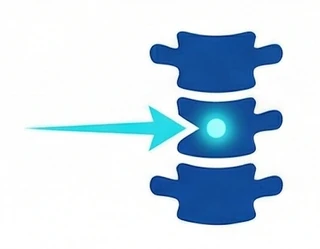
The bones of the spine are stacked in an orderly column. Spondylolisthesis is when one vertebra slips forward more than it should relative to the one below it, so the alignment of the spine is altered — and in some people, the slipped segment also moves abnormally with motion, a state called instability.
When a vertebra slips, the channels the nerves travel through can narrow, so a nerve or the nerve canal may be compressed. That is why spondylolisthesis often comes together with back pain and leg symptoms.
Why does spondylolisthesis happen?
There are several causes, but the most common in adults are:
- Age-related degeneration (degenerative) — as we age, the discs, joints, and ligaments that hold the spine together gradually wear and loosen, allowing a vertebra to slip slowly. This is the most common type in older adults and usually occurs in the lower (lumbar) spine.
- A defect in the small bony bridge that locks the segment (isthmic) — from a crack or defect in the small piece of bone that normally locks the vertebra in place, which in some people dates back to a younger age.
- Less common causes, such as trauma, injury, or changes after surgery.
The degree of slippage ranges from very mild to marked. Doctors generally assess it from imaging together with the patient's actual symptoms — not from the "grade of slip" alone.
What are the symptoms of spondylolisthesis?
Some people with spondylolisthesis have no symptoms at all and are found incidentally on an X-ray taken for another reason. In those who do have symptoms, the common pattern is:
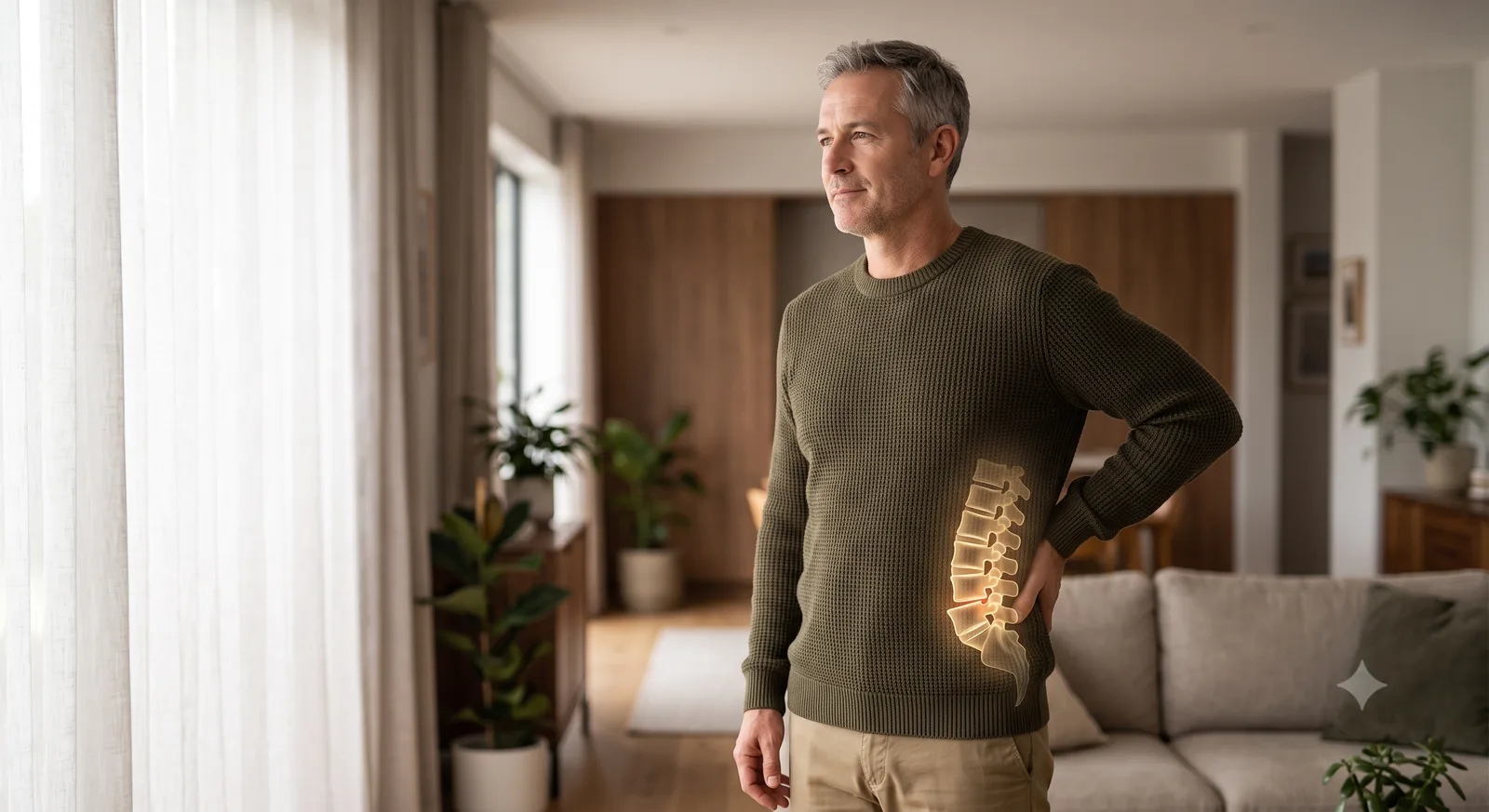
- Chronic low-back pain, often worse with prolonged standing or walking, arching the back, or activities that load the spine — and often easier when sitting or bending forward slightly.
- Pain or numbness radiating into the leg when the narrowed nerve channel compresses a nerve — possibly into the buttock, thigh, or down to the calf and foot.
- Walking shorter distances than before — some people walk a certain distance, then begin to ache or tire in the legs, have to stop or sit to let it settle, and can then walk on. (In medical terms this is neurogenic claudication, often seen when there is accompanying spinal-canal narrowing.)
- In more advanced cases, leg weakness or more pronounced numbness.
Note: the "walking shorter distances, having to stop and rest" pattern and spinal stenosis (which often accompanies a slipped vertebra) are explained in detail in a separate article → Spinal Stenosis: What It Is
A fact worth knowing: not everyone needs surgery
An important fact patients should understand from the outset is that many people with spondylolisthesis can have their symptoms improved with non-surgical care — particularly when symptoms are not severe, there is no clear weakness, or the slip is low-grade. Beginning with non-surgical care in suitable patients is therefore a reasonable approach.
In practice, doctors usually begin with non-surgical care in suitable patients and consider surgery only when full non-surgical care has not helped and symptoms still seriously disrupt daily life, or when clear neurological signs appear. The decision about surgery should be individualized together with a doctor, based on the severity of symptoms, the findings, and the response to treatment.
What does non-surgical care involve?
Non-surgical care (conservative treatment) for spondylolisthesis usually combines several approaches, such as:
- Adjusting daily activities and posture — avoiding postures or activities that flare the symptoms, such as heavy lifting, marked arching of the back, and prolonged continuous standing or walking, with rest breaks.
- Physical therapy and appropriate exercise — especially strengthening the core and back muscles to help support the spine, under the guidance of a doctor or physiotherapist.
- Medication to relieve pain and inflammation as advised by your doctor or pharmacist (taking anti-inflammatories on your own continuously for long periods without medical advice is not recommended).
- Targeted injections — such as an injection around the nerve canal or nerve root, in selected cases your doctor judges appropriate, to help relieve symptoms for a period.
The key to non-surgical care is consistency and follow-up, together with noting whether symptoms are improving, staying stable, or gradually worsening — especially any weakness or reduced walking distance — which helps guide the next decision with your doctor.
When should you not wait to see a doctor?
Although most spondylolisthesis symptoms come on gradually, a few warning signs indicate you should see a doctor promptly, without waiting it out, because they may signal severe nerve compression. These include:
- Progressively worsening leg weakness — for example, being unable to lift the foot or toes (foot drop), difficulty stepping, or worsening balance.
- Numbness in the buttock, perineum, or around the anus (the "saddle" area), or increasing numbness in both legs.
- Loss of bladder or bowel control — incontinence or inability to pass urine.
- Pain so severe that ordinary painkillers cannot relieve it, or fever together with back pain, or a history of cancer.
- A rapidly shrinking walking distance or clearly worsening leg symptoms over a short time.
These belong to a group covered in a separate article, with the reasons some of them should not wait → 5 Spine Red Flags You Should Never Ignore
If you have symptoms in this group, seeing a doctor quickly is not overreacting — it is protecting the nerve from lasting damage. Saddle-area numbness and loss of bladder or bowel control, in particular, should be assessed urgently.
If full non-surgical care has not helped: surgical options
If a patient has had appropriate non-surgical care for a period of time (the duration depends on the individual's symptoms and the doctor's judgement) but the back or radiating leg pain still seriously disrupts daily life, or there is clear weakness consistent with the MRI findings, the doctor may begin to discuss surgical options with the patient.
When surgery does come up, many patients worry that an operation automatically means "fusing the spine with screws." In fact, for many patients, "decompression" alone is enough. A randomized trial from Sweden that followed patients with spinal stenosis — with and without degenerative spondylolisthesis — found that adding fusion did not produce better outcomes than decompression alone, at both 2 and 5 years, while decompression alone involved less surgical burden.
What's more, performing that decompression with minimally invasive / endoscopic techniques disturbs the facet joints and the stabilizing structures less — part of why, in properly selected patients, decompression alone is often enough without fusion (the principle of being as minimally invasive as possible in suitable patients).
That said, when a vertebra is markedly slipped or clearly unstable, lumbar interbody fusion — stabilizing the abnormally moving segment — still has an important role; another trial found that adding fusion gave a small additional benefit in a selected group. Whether to do "decompression alone" or "add fusion" is therefore an individualized decision.
And when fusion genuinely is needed, the fusion itself also has a minimally invasive option. For selected patients, one such option is uniportal endoscopic-assisted lumbar interbody fusion, which uses an endoscope to help visualize and work through a small corridor. I want to be clear and honest: this is a technique that is still developing, used only in carefully selected patients, and open fusion or other minimally invasive (MIS) fusion techniques remain the correct, appropriate choice in many situations. For the details of who is and is not a suitable candidate, why some people need "fusion" rather than just "decompression," how the procedure is performed, the recovery time, and the honest risks, please see this page:
Read next: Uniportal Endoscopic-Assisted Lumbar Interbody Fusion — for Instability / Spondylolisthesis
The key point to understand: "operable" does not mean "must operate"
This is a common misunderstanding, so it is worth stating clearly: finding a slipped vertebra — or the fact that technology allows surgery through a smaller incision — does not mean that everyone with spondylolisthesis should have surgery. Choosing the right patient for the right treatment (patient selection) matters just as much as the surgical technique itself.
The uniportal endoscopic-assisted fusion approach in particular, being still developing, tends to suit low-to-moderate-grade slippage at a single level with suitable anatomy. Conversely, patients with severe slippage, marked instability, deformity, or a need to fuse multiple levels usually need a standard fusion operation (open, or another MIS technique) backed by more long-term data — which in those situations is the more appropriate and safer choice.
An appropriate decision therefore comes from a consultation with a spine specialist who has examined the patient, performed a physical examination, and reviewed the patient's MRI together — not from reading a single article (this one included). This article is only a starting point to help patients understand their condition and ask their doctor better questions.
FAQ
Q: My scan shows spondylolisthesis — is it dangerous, and do I need surgery right away?
A: Not necessarily. Many people with spondylolisthesis have mild symptoms and improve with non-surgical care, and some have no symptoms at all. Doctors generally consider surgery when full non-surgical care has not helped and symptoms still seriously disrupt daily life, or when there is weakness or a warning sign. The decision is individualized.
Q: Why do some people with spondylolisthesis need "fusion," not just "decompression"?
A: In fact, many patients who need surgery do well with decompression alone (one trial found that adding fusion did not improve outcomes in many cases). Fusion is considered when a vertebra is markedly slipped or clearly unstable, to stabilize the abnormally moving segment. It depends on the individual assessment (details on the procedure page).
Q: I can only walk a certain distance, then have to rest before walking on — is that spondylolisthesis?
A: The pattern of "walking a while, having to stop and rest, then walking on" can relate to spinal stenosis, which often accompanies spondylolisthesis — but it can also have other causes, so it should be assessed by a doctor to find the true cause (more in the spinal-stenosis article).
Q: After fusion surgery, is it cured for good and won't come back?
A: Fusion stabilizes the unstable segment, so symptoms usually improve — but it does not stop the natural degeneration of the spine over the long term, and solid bony fusion takes many months (and in some patients the bone may not fully fuse). It is not a "permanent cure," which is why ongoing self-care and follow-up matter (details on the procedure page).
Q: Is endoscopic fusion suitable for every kind of spondylolisthesis?
A: No. The uniportal endoscopic technique is still developing and tends to suit low-to-moderate-grade slippage at a single level. Severe slippage, marked instability, or multilevel cases usually need a standard fusion operation. Individualized assessment from the MRI is essential (more on the procedure page).
Every patient's situation differs in its details. This information helps with the overall picture, but decisions should be individualized together with a spine specialist.
References
- Försth, P., Ólafsson, G., Carlsson, T., et al. (2016). "A Randomized, Controlled Trial of Fusion Surgery for Lumbar Spinal Stenosis." New England Journal of Medicine, 374(15):1413–1423. [Link]
- Ghogawala, Z., Dziura, J., Butler, W. E., et al. (2016). "Laminectomy plus Fusion versus Laminectomy Alone for Lumbar Spondylolisthesis." New England Journal of Medicine, 374(15):1424–1434. [Link]
- Jitpakdee, K., Liu, Y., Heo, D. H., Kotheeranurak, V., Suvithayasiri, S., & Kim, J. S. (2023). "Minimally invasive endoscopy in spine surgery: where are we now?" European Spine Journal, 32(8):2755–2768. [Link]
- Wu, P. H., Kim, H. S., An, J. W., et al. (2023). "Prospective Cohort Study with a 2-Year Follow-up of Clinical Results, Fusion Rate, and Muscle Bulk for Uniportal Full Endoscopic Posterolateral Transforaminal Lumbar Interbody Fusion." Asian Spine Journal, 17(2):373–381. [Link]
- Zhang, Y., Ju, J., & Wu, J. (2026). "Uniportal endoscopic lumbar interbody fusion versus minimally invasive transforaminal lumbar interbody fusion for the treatment of lumbar degenerative diseases: a systematic review and meta-analysis." European Journal of Medical Research, 31(1):238. [Link]

Questions about your symptoms?
Chat with us on LINE for more information
@bright.endospine
Chat on LINE