Endoscopic Decompression for Lumbar Spinal Stenosis
Pain or heaviness in the legs and calves when you walk or stand for a while — pain that forces you to stop and rest, and that eases when you sit down or bend forward — is often the hallmark of lumbar spinal stenosis. Stenosis is an age-related narrowing of the channels the spinal nerves travel through, which presses on those nerves (a pattern doctors call neurogenic claudication). When medication, physical therapy, and activity changes have been tried fully and symptoms still interfere with daily life, surgery may be considered to relieve the compression. One of the less invasive options available today is full-endoscopic decompression. In this article I want to explain, in plain language, what this operation is, who is and isn't a good candidate, how it is done, and how to care for yourself afterward.
What is lumbar spinal stenosis, and what is endoscopic decompression?
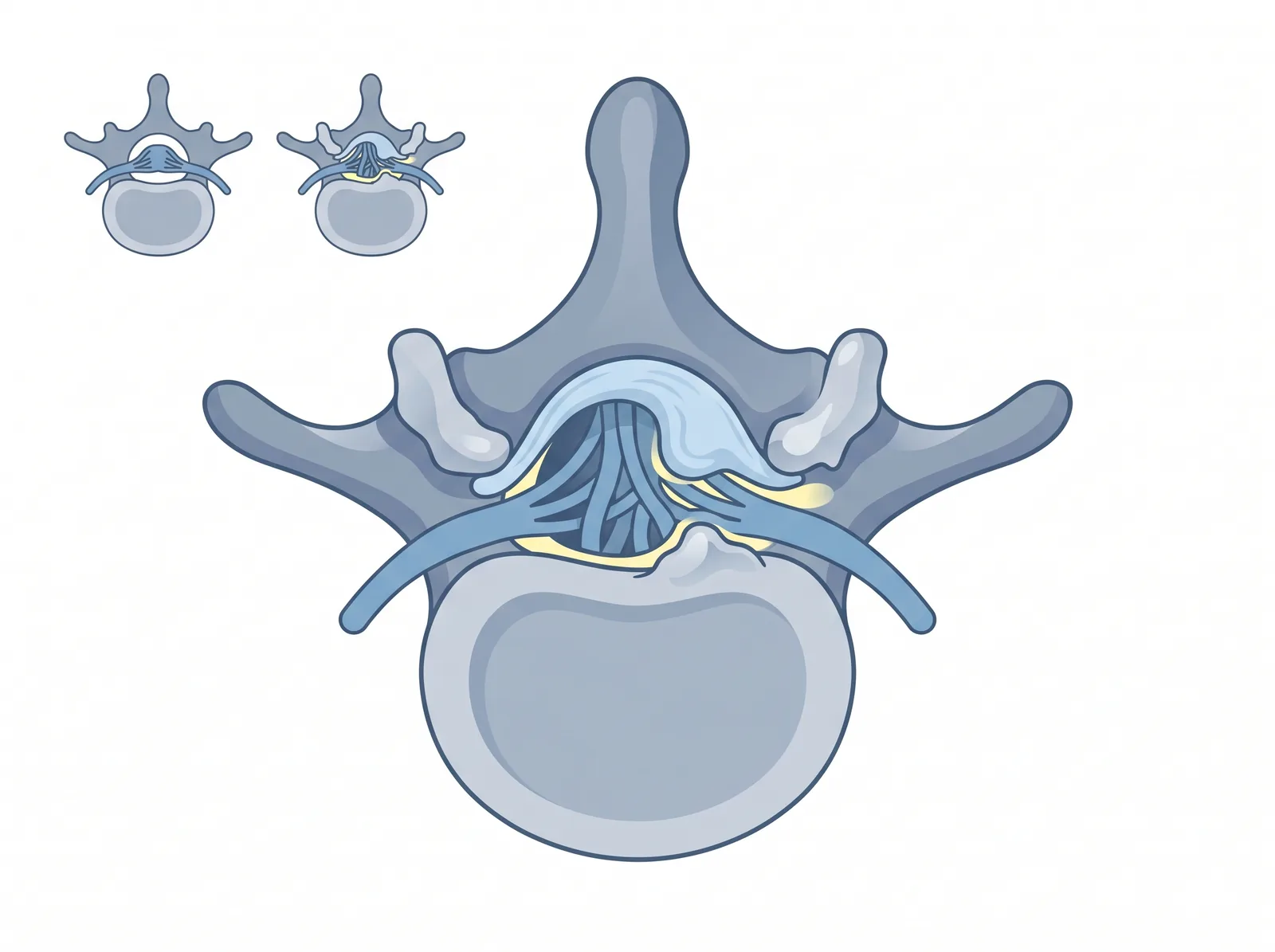
In spinal stenosis, the spaces the nerves pass through — both the central canal and the lateral recesses — narrow because of several factors that usually occur together: disc degeneration/bulging, thickening of a ligament (the ligamentum flavum), and bone overgrowth. The result is pressure on the nerves.
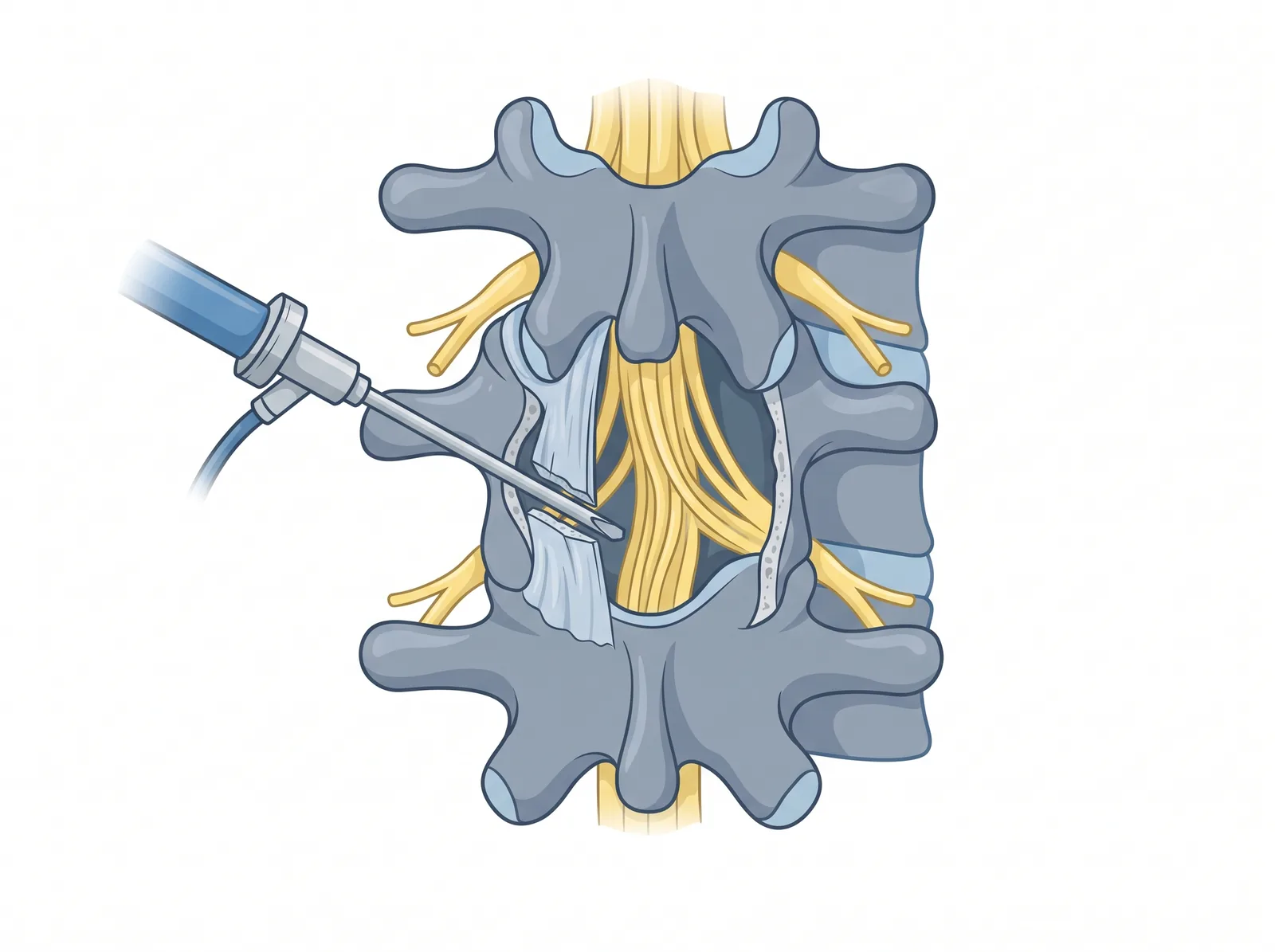
The principle of endoscopic decompression is to pass a high-definition endoscope through a small incision to reopen space for the nerve — removing only the structures that are pressing on it (such as the thickened ligament or a portion of bone) to relieve the compression. The technical feature is that it disturbs the surrounding muscle and structures as little as possible (muscle-sparing), and in many cases the surgeon can decompress both sides through a single small incision on one side. A continuous saline irrigation system keeps the view of the nerve clear throughout.
For the big picture of what endoscopic spine surgery is, see the overview article; and to understand the condition itself, see
Who it is for — and who it is NOT for (the honest version)
Endoscopic decompression is not right for every patient or every pathology. Choosing the right patient matters just as much as the surgical technique itself — and in stenosis the key questions are whether compression is genuinely the dominant problem, and whether there is any accompanying slippage or instability.
Often suitable when:
- Central or lateral-recess narrowing is compressing the nerves, causing neurogenic claudication (limited walking distance) or radiating leg pain, with a location that matches the MRI.
- Appropriate non-surgical care has been tried for a reasonable period and symptoms still disrupt daily life.
- Compression is the dominant problem and the spine is still adequately stable (fusion is not required).
Not the best choice in some situations, such as:
- Significant spinal slippage / instability (spondylolisthesis) that requires fusion.
- Severe multi-level stenosis together with significant spinal deformity (such as scoliosis in older adults).
- Certain pathologies where standard open surgery remains the safer and more appropriate option.
On indications — when endoscopy is not the right call, and why patient selection matters — see
How it is done (the approach)
Details are individualized, but the general flow is:
- Anesthesia — selected for each patient together with the anesthesiologist.
- A small incision — the muscle fibers are gently dilated (not stripped over a wide area).
- Guiding the endoscope to the narrowing — using MRI planning and intra-operative X-ray for positioning.
- Relieving the compression — under high-definition magnification and continuous irrigation, removing only the structures that press on the nerve (thickened ligament / a portion of bone) to reopen space; in some cases both sides can be decompressed through a single-side incision.
- Closure — because the incision is small, only minimal closure is usually needed.
Endoscopic surgery relies on a precise MRI to plan the trajectory — see
Recovery — what to realistically expect
- Most patients are able to get up and walk relatively soon after surgery, and typically stay in hospital about 1–2 days.
- Because most stenosis patients are older adults, recovery is individualized to overall health, other medical conditions, and pre-operative mobility.
- Limited walking distance and radiating leg pain often improve gradually, but activity should be increased step by step, following post-operative guidance closely — especially walking regularly and avoiding bending, heavy lifting, and twisting in the early period.
For post-op care, hospital-stay length, and returning to driving, see
Risks & honest limits (educational, not alarmist)
Every operation carries risk, even with a small incision. Risks to be aware of include:
- Recurrence of symptoms / re-stenosis: decompression fixes the mechanical problem at that spot but does not stop the natural degeneration of the spine, so symptoms can return over the long term — this is not a "permanent cure."
- Dural tear / CSF leak: uncommon, but possible.
- Infection: overall, endoscopic surgery has been reported to have a very low infection rate [see references].
- Incomplete decompression, or the emergence of instability that may, in some cases, require a different operation (such as fusion).
On the chance of recurrence and the factors involved, see
FAQ
Does endoscopic decompression cure spinal stenosis for good?
Surgery relieves the compression, so symptoms usually improve — but it does not halt the natural degeneration of the spine, so symptoms can return over the long term. Ongoing self-care and follow-up matter.
RecurrenceCan multi-level stenosis be treated endoscopically?
It depends on whether the narrowing is genuinely the dominant problem, whether there is accompanying slippage/instability, and how severe any deformity is. Some cases suit decompression; others need a different approach. Individualized assessment from the MRI is essential.
Indications for EndoscopyIf I also have spinal slippage, can I still have endoscopic decompression?
If there is significant instability/slippage, decompression alone may not be enough, and fusion may need to be considered as well. It depends on the individual assessment.
(Every case is different and decisions should be individualized. Consultation with a spine specialist is strongly recommended to assess your actual symptoms.)
References
- Jitpakdee, K., Liu, Y., Heo, D. H., Kotheeranurak, V., Suvithayasiri, S., & Kim, J. S. (2023). "Minimally invasive endoscopy in spine surgery: where are we now?" European Spine Journal. [Link]
- Chin, B. Z., et al. (2024). "Full-endoscopic versus microscopic spinal decompression for lumbar spinal stenosis: a systematic review & meta-analysis." The Spine Journal. [Link]
- Ruetten, S., Komp, M., Merk, H., & Godolias, G. (2009). "Surgical treatment for lumbar lateral recess stenosis with the full-endoscopic interlaminar approach versus conventional microsurgical technique: a prospective, randomized, controlled study." Journal of Neurosurgery: Spine. [Link]
- Komp, M., et al. (2015). "Bilateral spinal decompression of lumbar central stenosis with the full-endoscopic interlaminar versus microsurgical laminotomy technique: a prospective, randomized, controlled study." Pain Physician. [Link]

Questions about your symptoms?
Chat with us on LINE for more information
@bright.endospine
Chat on LINE